When Management Makes or Breaks You: A Carer’s Story

National Employee Appreciation Day, held on the first Friday of March each year, is an opportunity for organisations to celebrate their staff, recognise those who go the extra mile, and acknowledge the contribution employees make to business success.
Recognition does not always have to come in the form of financial reward. While bonuses and pay increases are welcome, appreciation can also be demonstrated through understanding, flexibility and compassion. For employees who are also unpaid Carers, this kind of support is not simply “nice to have” — it is essential.
Connie’s Story
Unpaid, Carer, Connie shares her story. It illustrates clearly how the actions of a line manager — both negative and positive — can have a profound impact, and how tools such as a Carer Friendly ID card and a Carer’s Passport can transform working life. The story below is based on a true story but the Carer has asked to remain anonymous so her name and photograph is fictitious.
Balancing Work and Family
In 2022, I had been in my job for almost thirty years. I didn’t work for a bad employer. In fact, the organisation itself was generally supportive. The biggest issue I encountered was that so much depended on your line manager.
This isn’t a criticism of line managers as a whole — I’ve been one myself, and I hope I was one of the good ones. But when a manager gets it wrong, they can make your life incredibly difficult.
At the time, my mum and I were caring for my dad, whose health was failing. I was juggling full-time work alongside my caring responsibilities. Then Mum was diagnosed with a heart condition and told she needed surgery. We were reassured it was routine and that her hospital stay would be no more than three nights.
I booked a week of annual leave to care for Mum after her discharge and explained everything to my line manager. They appeared supportive, and I was fortunate that my workplace was within walking distance of the hospital.
When Plans Fall Apart
Mum’s operation initially seemed successful, but her recovery didn’t go as expected. It turned out she had suffered internal bleeding that had gone unnoticed. Instead of three nights, she was kept in hospital for seven.
By the time she was discharged, most of my annual leave had already been used. Because it was peak holiday time, I had not been allowed to move my leave. I asked my line manager for an additional three days to care for Mum. In truth, I needed more, but I was loyal and didn’t want to let my team down.
The phone call that followed still upsets me when I think about it. My manager conducted it on speakerphone in an open office. I could hear colleagues in the background. She asked deeply personal questions, and I had to discuss my father’s incontinence, my mother’s enforced bed rest, and the support arrangements that were ending. I found myself pleading for time off.
She refused.
After further begging, I was allowed just one day working from home — no more — because she was going on holiday and the office supposedly couldn’t be left unattended, despite there being nine people in the team.
I escalated the matter to the next managerial level. That meeting was even worse. The response I received was so hostile that I left the room in tears and sought comfort from trusted colleagues.
The Breaking Point
The strain of working full-time on site — when others were allowed to work from home — while caring for two seriously ill parents became overwhelming. I wasn’t allowed to leave early. There was no flexibility. Eventually, I suffered a breakdown.
My GP was incredibly compassionate. She even phoned Mum to check on her recovery. Mum must have expressed concern about me, because the GP called me at work and signed me off immediately. I was off for a month.
When I returned, things deteriorated further. I was excluded from meetings, given tasks requiring late working, moved from the manager’s office into a communal space, and assigned extra responsibilities that colleagues at my level did not have. It felt like punishment.
On my GP’s advice, I wrote to management detailing the impact their actions had on my mental and physical health, copying in Occupational Health. Shortly afterwards, I was invited to a meeting where — reluctantly — reasonable adjustments were agreed. I suspect my managers had been challenged over their handling of the situation.
But the damage had been done. I was miserable and close to leaving a career of nearly three decades just to escape.
A Second Chance
Then something changed. A secondment opportunity arose in another team.
It was like stepping into a different world.
My new line manager and colleagues showed empathy, understanding, and trust. For the first time in a long while, I felt supported.
My organisation operates a Carer’s Passport scheme — a document completed with your line manager to record reasonable adjustments without going through a formal HR contract change. Adjustments are reviewed annually.
I was able to reference my Forward Carers Carer Friendly ID card, which formally verified my status as a carer, even though we did not qualify for benefits or Attendance Allowance. This gave additional weight to my Carer’s Passport application.
Practical Support That Makes a Difference
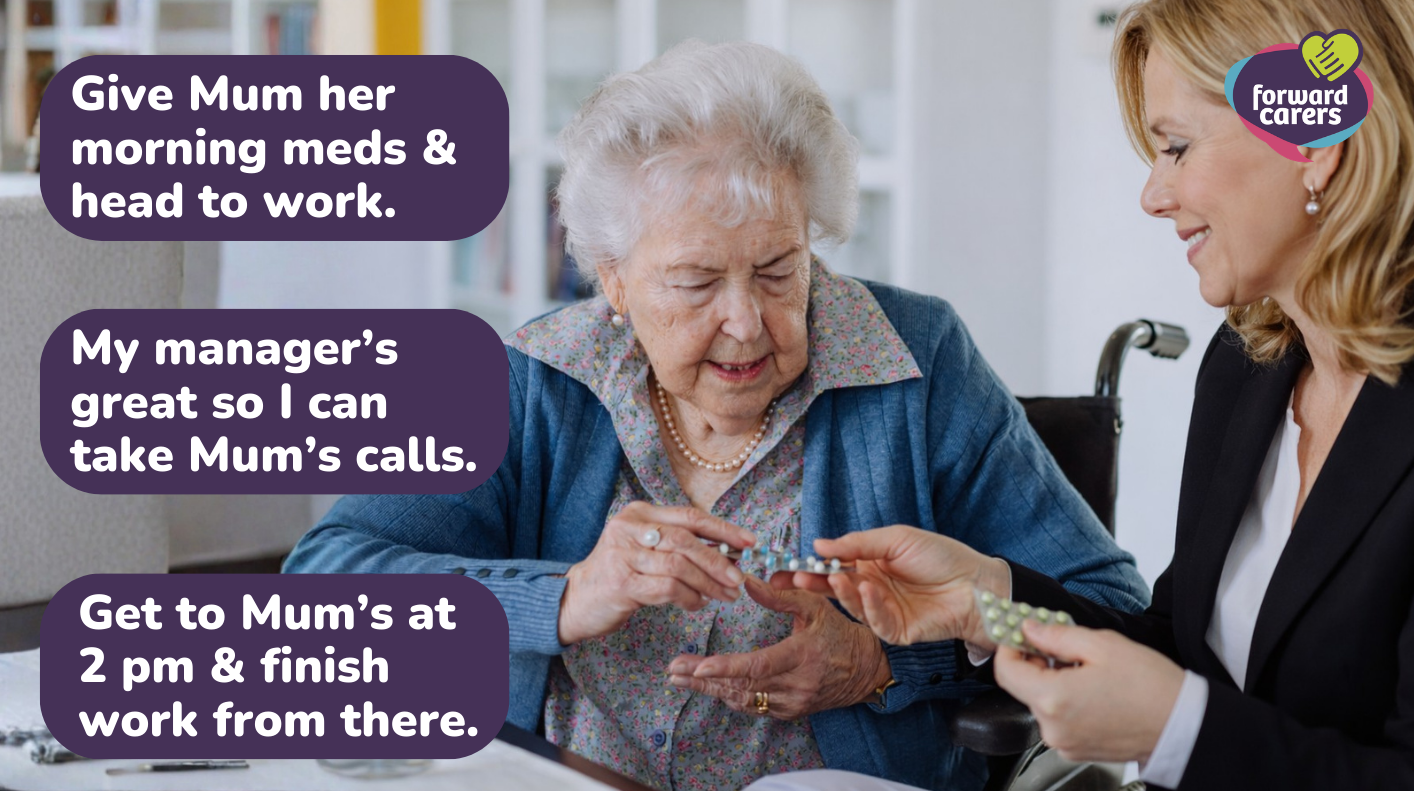
Through the Carer’s Passport, I now have agreed adjustments, including:
- Working from home during extreme weather to ensure Mum is safe
- Leaving work mid-afternoon and completing my hours from home
- The flexibility to leave work immediately if Mum needs me
Importantly, the Passport protects both me and my manager. It provides clarity and reassurance if my working pattern is ever questioned.
Following new government legislation introducing the right to one week’s unpaid Carer’s Leave, my organisation went further and offers one week of paid leave for carers with a Passport in place.
I’ve used this leave to take Mum to a funeral, attend solicitor appointments for probate after Dad passed away, and accompany her to lengthy hospital appointments. For shorter appointments, I simply make up the time.
The Power of Good Leadership
My secondment has since become permanent. I now work in a genuinely caring environment. The last three years at home have been traumatic, but with a good manager, a supportive team, and the structure of the Carer’s Passport, I have coped far better than I ever could have before.
I truly believe that if I had remained under my original manager, I would have experienced a complete breakdown and likely left work altogether with severe depression.
A Final Message to Managers
If you manage people, please remember this:
Treat the people you lead as you would want to be treated yourself.
Flexibility, empathy, and basic human decency cost nothing — but they can mean everything to someone quietly holding their world together outside of work.
Connie
How to Get a Carer Friendly ID Card?
You can access a Carers ID Card free of charge if you live or are caring for someone in one of our commissioned areas such as Birmingham. You can find out more about the Carers ID Card on this page, and apply for your free card by completing this form.
How to Get Support at Work
Find out advice around working and caring.
Join Forward Carers for an informative online session exploring Carers leave and your rights in the workplace.
Join us for an online event to learn about the Carer Friendly ID Card and how it has been designed to help your life as a Carer.